Have you ever received a message like “ion care” or “ion wanna go” and paused for a second? 🤔 You’re not alone. The ion meaning in text has become extremely popular in modern digital conversations, especially on social media and casual chats.
This guide will break down what “ion” means in text messages, where it comes from, how people use it, and how you can understand it confidently without feeling out of the loop. 🚀 Whether you’re a student, parent, content creator, or just curious, this article gives you the full expert-level explanation in simple words.
By the end, you’ll know exactly how to read, use, and respond to “ion” naturally — just like a native texter. 😊
What Does ION Mean in Text? 📱
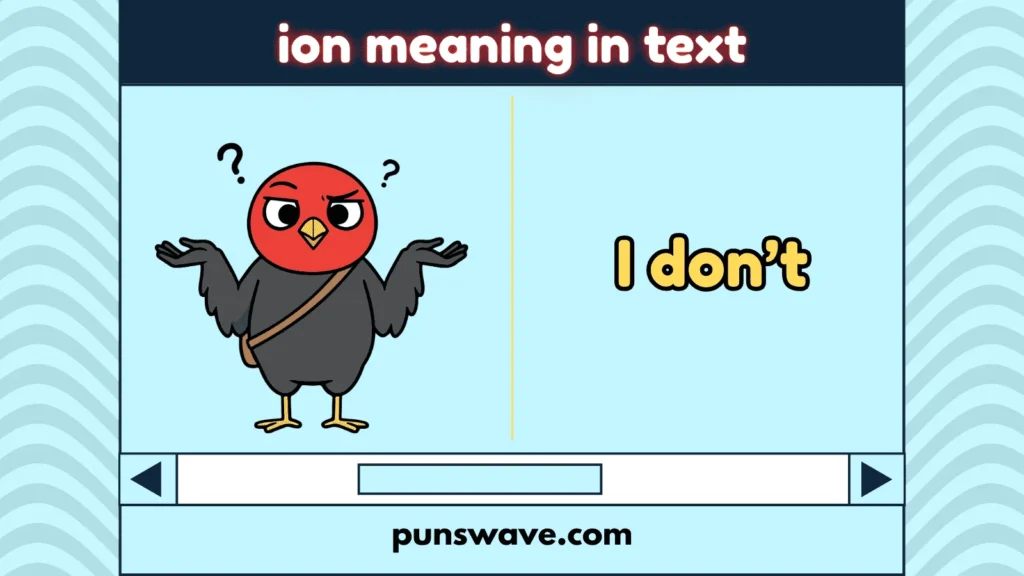
In texting and online chat, ION is an informal slang term that usually means:
ION = “I don’t”
So when someone types “ion know”, they are saying:
“I don’t know.”
This abbreviation removes the apostrophe and shortens the phrase to sound more casual and fast-paced — perfect for texting culture. ⚡
The ion meaning in text depends on context, but most of the time, it replaces:
- I don’t care → ion care
- I don’t know → ion know
- I don’t want → ion want
- I don’t like → ion like
It’s casual, conversational, and very common among younger users. 😎
ION Meaning in Text vs Dictionary Meaning ⚖️
Here’s where many people get confused.
In science, an ion is a charged atom or molecule. ⚛️ But in texting, the ion meaning in text has nothing to do with chemistry.
| Context | Meaning |
|---|---|
| Science | Charged particle (positive or negative) |
| Texting / Slang | Short form of “I don’t” |
Understanding context is key. If you see “ion” in a casual chat, it’s almost always slang — not science. 😊
Origin of ION Slang Meaning 🕰️
The slang use of ion originated from spoken English, particularly in informal speech where:
“I don’t” often sounds like “I-on” when spoken quickly.
Over time, people started spelling it the same way it sounded — ion.
This usage became popular in:
- Text messaging 📩
- Twitter / X 🐦
- TikTok comments 🎵
- Instagram captions 📸
- Online chats & gaming 🎮
The ion meaning in text grew fast because it feels natural, quick, and expressive.
How ION Is Used in Text Conversations 💬
ION usually appears at the beginning of a sentence. It replaces the phrase “I don’t” without changing the meaning.
Common Sentence Structures
- ion + verb
- ion + feeling
- ion + opinion
This keeps messages short and informal — perfect for modern digital communication.
Examples of ION Meaning in Text ✍️
Here are real-life examples to help you understand the tone and usage:
- “ion care what they say” → I don’t care what they say
- “ion think that’s true” → I don’t think that’s true
- “ion wanna argue” → I don’t want to argue
- “ion know yet” → I don’t know yet
- “ion like that idea” → I don’t like that idea
As you can see, the meaning stays the same — only the style changes. 😄
Emotional Tone of ION in Text 😌
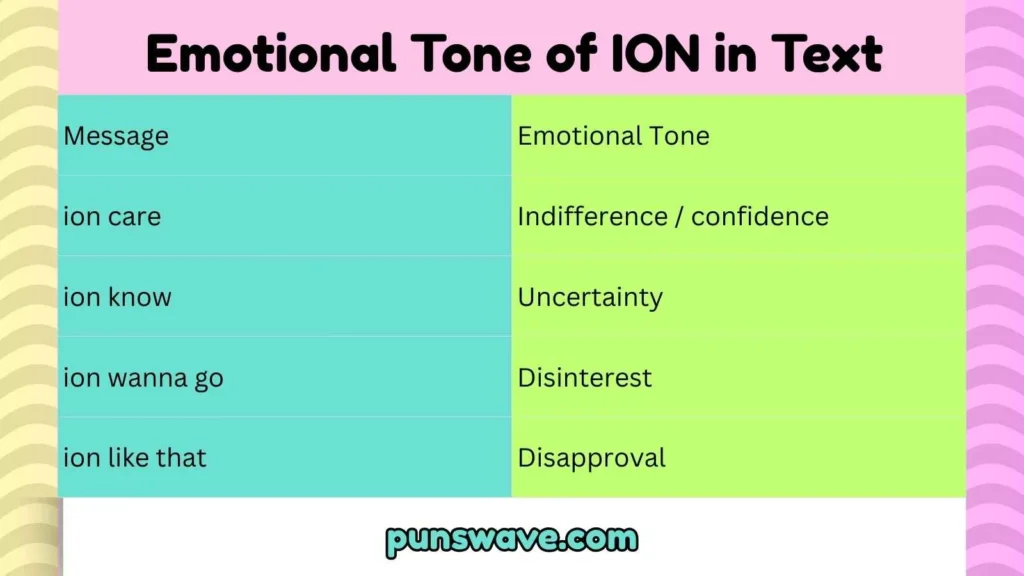
The ion meaning in text often carries emotion depending on context:
| Message | Emotional Tone |
|---|---|
| ion care | Indifference / confidence |
| ion know | Uncertainty |
| ion wanna go | Disinterest |
| ion like that | Disapproval |
It can sound casual, relaxed, or even slightly dismissive — so tone matters. 🎯
ION vs IDK vs IDC 🤔
People often compare these abbreviations. Let’s clarify:
| Term | Meaning | Usage Style |
|---|---|---|
| ION | I don’t | Casual, slang-heavy |
| IDK | I don’t know | Neutral, common |
| IDC | I don’t care | Direct, sometimes blunt |
ION feels more conversational and expressive than traditional abbreviations. 👍
Is ION Formal or Informal? 🚫📄
ION is strictly informal.
Avoid using it in:
- Professional emails
- Academic writing
- Workplace communication
- Formal documents
Use it only in casual chats, social media, or friendly conversations. 😊
Why Is ION So Popular in Texting? 🔥
The popularity of the ion meaning in text comes from:
- Faster typing ⌨️
- Natural speech style 🗣️
- Youth-driven trends 👥
- Social media influence 📱
People want messages that feel real — not robotic. ION delivers that tone perfectly.
Common Misunderstandings About ION ❌
Some people mistakenly think:
- ION is rude ❌
- ION is a typo ❌
- ION means something negative ❌
In reality, it’s just casual slang. Context determines tone, not the word itself. 🙂
Should You Use ION in Your Own Messages? 🤷
Yes — if:
- You’re texting friends
- You’re chatting casually
- You want a relaxed tone
No — if:
- You’re talking to a boss
- You’re writing formally
- You want to sound professional
Match your language to your audience. 🎯
ION Meaning in Text on Social Media 📲
On platforms like TikTok, Instagram, and Twitter, ION appears in:
- Captions
- Comments
- Replies
- DMs
Example:
“ion chasing nobody — peace only ✨”
It adds personality and attitude without extra words.
Related Slang You Might See 🔍
If you understand ION, these will also make sense:
- IDC – I don’t care
- IDK – I don’t know
- FR – For real
- SMH – Shaking my head
FAQs:
What does ion mean in texting?
ION means “I don’t” in casual text messages.
Is ion rude or disrespectful?
No. It’s informal but not rude by default. Tone depends on context.
Can ion mean anything else?
In texting, it almost always means “I don’t.” Other meanings depend on context.
Is ion used worldwide?
Yes, especially in English-speaking online communities.
Should adults use ion?
Yes, if the conversation is casual and informal.
Final Thoughts:
The ion meaning in text is simple once you know it. It’s a casual, modern way to say “I don’t”, used widely across chats and social platforms.
Understanding slang like ION helps you:
- Communicate naturally
- Avoid confusion
- Stay current with digital language
Language evolves — and texting slang is part of that evolution. Embrace it wisely. 😊

I love exploring the meaning behind words and ideas, turning simple thoughts into clear and engaging content. At Punswave, I focus on explaining meanings in an easy and interesting way for everyone.