Have you ever been texting a friend, and they suddenly type “HBU?” and you pause, unsure what it means? 😅 You’re not alone! In today’s fast-paced digital world, abbreviations like HBU are everywhere. Understanding them is not just helpful—it’s essential to keep your chats smooth, relatable, and fun.
In this comprehensive guide, we’ll break down everything about HBU meaning in text, including its origin, examples, proper usage, and even some fun tips to stay ahead in texting slang. By the end, you’ll feel confident texting like a pro! 🚀
What Does HBU Mean? 🤔
HBU is an abbreviation commonly used in digital conversations. It stands for “How About You?” It’s a simple, friendly way to turn the conversation back to the other person after answering a question or sharing your opinion. For example:
- Friend 1: “I had an amazing weekend! Went hiking 🥾. HBU?”
- Friend 2: “That sounds awesome! I just stayed home and relaxed 😌.”
Notice how HBU naturally invites a response and keeps the conversation flowing smoothly. It’s short, casual, and perfect for texting.
Origin of HBU 🕰️
The term HBU emerged in the early 2000s with the rise of texting and online chatting. As messages needed to be fast, concise, and clear, people began shortening common phrases. HBU quickly became popular on platforms like:
- AOL Instant Messenger (AIM)
- SMS texting
- Facebook Messenger and WhatsApp
- Snapchat and Discord
It’s part of a long tradition of digital slang designed to save time and make typing easier. Think of it as the modern-day “What’s up?” but more direct. 💬
Why People Use HBU in Texts ✨
There are several reasons why HBU has become a staple in texting:
- Quick Communication: Saves time while keeping the conversation engaging.
- Shows Interest: Asking “HBU?” shows that you care about the other person’s feelings or opinion.
- Informal Tone: Perfect for friendly chats, casual conversations, and social media DMs.
- Easy to Remember: Only three letters—hard to forget! 😄
How to Use HBU in Text Messages 📝

Using HBU is easy, but knowing the right context is key. Here’s how to do it:
1. After Sharing Your Experience
- “I had sushi for lunch 🍣. HBU?”
- “Watched the new Marvel movie last night 🎬. HBU?”
2. In Casual Conversations
- Friend 1: “Feeling tired today 😴.”
- Friend 2: “Same here! HBU?”
3. On Social Media
HBU is often used in comments, replies, or DMs to keep interactions engaging:
- “Just finished my workout 💪. HBU?”
- “Weekend plans sorted! HBU?”
HBU in Different Contexts 🌎
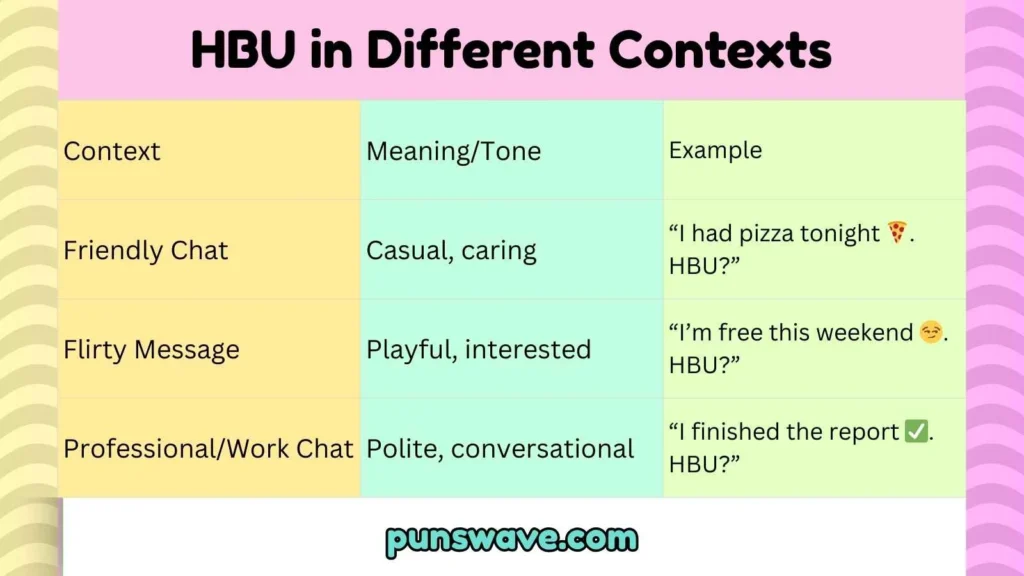
While HBU generally means “How About You?”, its tone can slightly change based on context:
| Context | Meaning/Tone | Example |
|---|---|---|
| Friendly Chat | Casual, caring | “I had pizza tonight 🍕. HBU?” |
| Flirty Message | Playful, interested | “I’m free this weekend 😏. HBU?” |
| Professional/Work Chat | Polite, conversational | “I finished the report ✅. HBU?” |
HBU vs Similar Abbreviations 🔍
Texting slang is full of short forms, and sometimes it’s easy to confuse them. Here’s how HBU compares:
- HBU vs. WBU: WBU = “What About You?” Same meaning, slightly less casual.
- HBU vs. UR: UR = “You Are,” completely different usage.
- HBU vs. HMU: HMU = “Hit Me Up,” invitation to chat rather than asking a question.
Examples of HBU in Real Conversations 💬
Seeing HBU in action helps solidify understanding. Here are 10 examples:
- “Just got a new puppy 🐶! HBU?”
- “I’m watching Stranger Things tonight 📺. HBU?”
- “Tried that new café downtown ☕. HBU?”
- “Finished my exams today 🎓. HBU?”
- “I’m feeling super excited about the trip ✈️. HBU?”
- “Had a productive day at work 💼. HBU?”
- “I’m planning a movie night 🎥. HBU?”
- “I started reading a new book 📚. HBU?”
- “Just went for a run 🏃. HBU?”
- “I’m baking cookies 🍪 today. HBU?”
Why HBU is Popular Among Teens and Young Adults 🧑🤝🧑
HBU thrives among younger audiences because it’s:
- Fast: Minimal typing effort.
- Friendly: Encourages peer engagement.
- Trendy: Fits with digital culture.
- Relatable: Works in group chats, DMs, and even text chains with friends.
Fun Facts About HBU 🎉

- HBU is often combined with emojis to express emotions quickly.
- It’s widely used in texting apps but less so in emails or formal writing.
- It’s considered polite because it shows you’re interested in the other person.
Common Mistakes When Using HBU ❌
Even small abbreviations can be misused. Avoid these:
- Using HBU in professional emails – stick to full phrases like “How about you?”
- Overusing it – repeated HBU can feel robotic.
- Misinterpreting it – don’t confuse it with HMU or WBU.
Tips to Use HBU Like a Pro 💡
- Use it naturally in conversations, not forced.
- Pair it with emojis for a friendly tone.
- Combine it with personal experiences to keep chats engaging.
- Mix it with other casual abbreviations, but avoid overwhelming the reader.
FAQs
1. Is HBU formal or informal?
Answer: HBU is informal and best used in casual conversations or social media messages. Avoid using it in business emails. 💼
2. Can I use HBU in group chats?
Answer: Absolutely! HBU works well in group chats to check on multiple friends at once. 👥
3. Is HBU the same as WBU?
Answer: Yes, WBU (“What About You?”) is very similar. HBU is slightly more casual and common in texting. ✨
4. Can HBU be used in dating apps?
Answer: Definitely! It’s a friendly, engaging way to show interest and keep the conversation going. 💌
Conclusion:
HBU meaning in text is simple yet powerful. It’s a friendly, casual way to ask “How About You?” and keep conversations flowing naturally.
From social media to texting friends, HBU is everywhere—and knowing how to use it correctly will make your digital chats more engaging, relatable, and fun. 🎯
Next time you see HBU pop up in your messages, you’ll know exactly how to respond and even use it like a pro. Remember, texting slang like HBU is not just about shortcuts—it’s about connection, engagement, and personality in your conversations. 💌

I love exploring the meaning behind words and ideas, turning simple thoughts into clear and engaging content. At Punswave, I focus on explaining meanings in an easy and interesting way for everyone.